- Home
- Destinations
- Gorilla Tours
- Uganda Gorilla Tours
- 3-Day Bwindi Gorilla Trekking Express
- 4-Day Bwindi Gorillas & Lake Bunyonyi Relaxation
- 5-Day Bwindi Gorillas & Queen Elizabeth Wildlife Safari
- 7-Day Ultimate Uganda Primates (Gorillas & Chimps)
- 10-Day Highlights of Uganda (Gorillas, Chimps, & Savannah Wildlife)
- 12-Day Active Adventure: Gorillas, Wildlife, & Rwenzori Foothills
- Rwanda Gorilla Tours
- Luxury Gorilla Treks
- 3-Day Exclusive Luxury Gorilla Safari to Bwindi (Clouds Mountain Gorilla Lodge)
- 4-Day Elite Rwanda Gorilla Experience (Bisate / One&Only Gorilla’s Nest)
- 6-Day Ultra-Luxury Rwanda Gorillas & Nyungwe Canopy Tour
- 8-Day Premium Uganda Gorilla & Savannah Luxury Voyage (Apoka & Sanctuary Gorilla Forest Camp)
- 10-Day Connoisseur Uganda & Rwanda Dual Luxury Gorilla Tour
- 12-Day Signature East African Luxury Primate & Wildlife Safari
- Gorilla Fly-In Safaris
- 3-Day Fly-in Gorilla Trekking to Bwindi (Via Entebbe)
- 4-Day Luxury Fly-in Gorillas & Queen Elizabeth Safari
- 5-Day Fly-in Primates: Bwindi Gorillas & Kibale Chimps
- 5-Day Rwanda Fly-in Helicopter Safari (Akagera & Volcanoes)
- 6-Day Luxury Fly-in Kidepo Valley & Bwindi Gorillas
- 8-Day Premium Fly-in Uganda Wilderness Circuit
- Gorilla Habituation Treks
- 3-Day Bwindi Gorilla Habituation Experience (Rushaga Sector)
- 4-Day Gorilla Habituation & Batwa Cultural Encounter
- 5-Day Double Habituation: Bwindi Gorillas & Kibale Chimpanzees
- 6-Day Gorilla Habituation & Queen Elizabeth Wildlife Safari
- 7-Day Exclusive Primate Habituation & Lake Bunyonyi Retreat
- 9-Day Deep Jungle Habituation & Wildlife Conservation Tour
- Combined Uganda & Rwanda Tours
- 5-Day Double Gorilla Trekking (Bwindi & Volcanoes National Park)
- 7-Day Rwanda & Uganda Primate Highlights
- 10-Day East African Wildlife & Gorilla Cross-Border Safari
- 12-Day Volcanoes, Bwindi, & Queen Elizabeth Mega Safari
- 14-Day Ultimate Uganda & Rwanda Discovery Tour
- 18-Day Grand East African Gorillas, Wildlife, & Culture Expedition
- Uganda Gorilla Treks From Kigali
- 1-Day Ultra-Express Uganda Gorilla Trek from Kigali
- 2-Day Budget Uganda Gorilla Safari via Kigali
- 3-Day Classic Bwindi Gorilla Trekking from Kigali
- 4-Day Bwindi Gorillas & Lake Bunyonyi via Kigali
- 5-Day Uganda Gorilla & Golden Monkey Trek via Kigali
- 6-Day Southwest Uganda Primate Safari (Bwindi & Mgahinga) via Kigali
- Uganda Gorilla Tours
- Gorilla Trekking
- Primate Guide
- Planning Guide
- About Us
Back
- Home
- Destinations
- Gorilla Tours
- Uganda Gorilla Tours
- 3-Day Bwindi Gorilla Trekking Express
- 4-Day Bwindi Gorillas & Lake Bunyonyi Relaxation
- 5-Day Bwindi Gorillas & Queen Elizabeth Wildlife Safari
- 7-Day Ultimate Uganda Primates (Gorillas & Chimps)
- 10-Day Highlights of Uganda (Gorillas, Chimps, & Savannah Wildlife)
- 12-Day Active Adventure: Gorillas, Wildlife, & Rwenzori Foothills
- Rwanda Gorilla Tours
- Luxury Gorilla Treks
- 3-Day Exclusive Luxury Gorilla Safari to Bwindi (Clouds Mountain Gorilla Lodge)
- 4-Day Elite Rwanda Gorilla Experience (Bisate / One&Only Gorilla’s Nest)
- 6-Day Ultra-Luxury Rwanda Gorillas & Nyungwe Canopy Tour
- 8-Day Premium Uganda Gorilla & Savannah Luxury Voyage (Apoka & Sanctuary Gorilla Forest Camp)
- 10-Day Connoisseur Uganda & Rwanda Dual Luxury Gorilla Tour
- 12-Day Signature East African Luxury Primate & Wildlife Safari
- Gorilla Fly-In Safaris
- 3-Day Fly-in Gorilla Trekking to Bwindi (Via Entebbe)
- 4-Day Luxury Fly-in Gorillas & Queen Elizabeth Safari
- 5-Day Fly-in Primates: Bwindi Gorillas & Kibale Chimps
- 5-Day Rwanda Fly-in Helicopter Safari (Akagera & Volcanoes)
- 6-Day Luxury Fly-in Kidepo Valley & Bwindi Gorillas
- 8-Day Premium Fly-in Uganda Wilderness Circuit
- Gorilla Habituation Treks
- 3-Day Bwindi Gorilla Habituation Experience (Rushaga Sector)
- 4-Day Gorilla Habituation & Batwa Cultural Encounter
- 5-Day Double Habituation: Bwindi Gorillas & Kibale Chimpanzees
- 6-Day Gorilla Habituation & Queen Elizabeth Wildlife Safari
- 7-Day Exclusive Primate Habituation & Lake Bunyonyi Retreat
- 9-Day Deep Jungle Habituation & Wildlife Conservation Tour
- Combined Uganda & Rwanda Tours
- 5-Day Double Gorilla Trekking (Bwindi & Volcanoes National Park)
- 7-Day Rwanda & Uganda Primate Highlights
- 10-Day East African Wildlife & Gorilla Cross-Border Safari
- 12-Day Volcanoes, Bwindi, & Queen Elizabeth Mega Safari
- 14-Day Ultimate Uganda & Rwanda Discovery Tour
- 18-Day Grand East African Gorillas, Wildlife, & Culture Expedition
- Uganda Gorilla Treks From Kigali
- 1-Day Ultra-Express Uganda Gorilla Trek from Kigali
- 2-Day Budget Uganda Gorilla Safari via Kigali
- 3-Day Classic Bwindi Gorilla Trekking from Kigali
- 4-Day Bwindi Gorillas & Lake Bunyonyi via Kigali
- 5-Day Uganda Gorilla & Golden Monkey Trek via Kigali
- 6-Day Southwest Uganda Primate Safari (Bwindi & Mgahinga) via Kigali
- Uganda Gorilla Tours
- Gorilla Trekking
- Primate Guide
- Planning Guide
- About Us


The Ultimate East Africa Primate Encyclopedia
Explore our complete encyclopedia of primates in Uganda and Rwanda. From mountain gorillas and chimpanzees to nocturnal bushbabies and rare colobus monkeys.
The East Africa Primate Encyclopedia: Every Species Profiled
Uganda and Rwanda protect the most diverse array of primates on the African continent. Across the Albertine Rift Valley, the combinations of high-altitude montane forests, low-land jungles, and savanna fringes shelter everything from 400-pound great apes to tiny, nocturnal primates that fit in the palm of your hand.
Use this master encyclopedia to identify the primates you will encounter on your safari with Uganda Rwanda Tours.
Class 1: The Great Apes (Hominidae)
The intelligent giants of the forest. Great apes lack tails, have large cranial capacities, and share complex social networks closely mirroring human behavior.
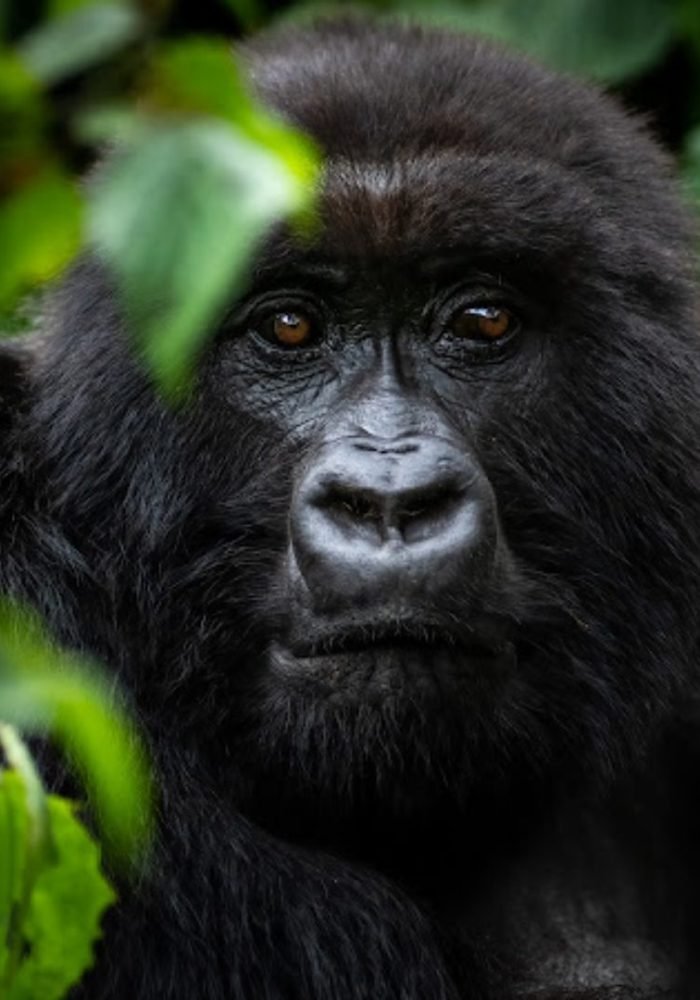
1. Mountain Gorilla (Gorilla beringei beringei)
Size: Up to 400 lbs (180 kg) for adult silverbacks.
Key Identification: Massive, muscular build, thick black fur (turns silver on the back of alpha males), unique individual nose prints.
Where to Find: Bwindi Impenetrable Forest & Mgahinga (Uganda), Volcanoes National Park (Rwanda).
Behavior Note: Ground-dwelling, gentle vegetarians living in tight-knit families led by a dominant silverback.
2. Common Chimpanzee (Pan troglodytes)
Size: 90 to 130 lbs (40 to 60 kg).
Key Identification: Pinkish-to-black faces, prominent ears, dynamic gestures, completely lack tails.
Where to Find: Kibale Forest, Budongo, Kyambura Gorge (Uganda), Nyungwe Forest (Rwanda).
Behavior Note: Highly vocal, aggressive hunters utilizing sophisticated stick tools to fish for termites or harvest honey.
Class 2: Old World Monkeys (Cercopithecidae)
Vibrant, highly adaptable, and possessing true tails (unlike apes). They display incredible variations in color, social habits, and dietary adaptations.
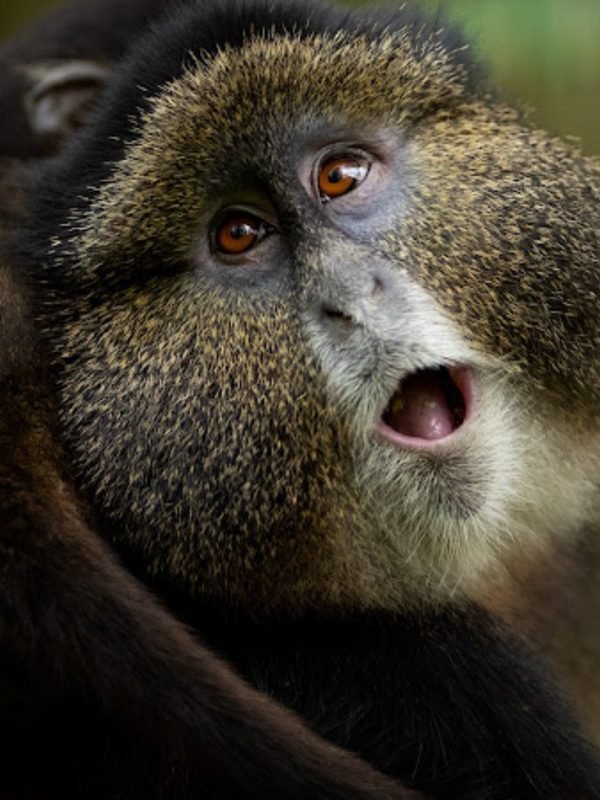
3. Golden Monkey (Cercopithecus kandti)
Key Identification: Bright golden-orange coat on their back and flanks, contrasted with black limbs.
Where to Find: Volcanoes National Park (Rwanda) and Mgahinga National Park (Uganda).
Dietary Focus: Strictly bamboo shoots, leaves, and seasonal wild fruits.
4. Mantled Guereza / Black-and-White Colobus (Colobus guereza)
Key Identification: Jet-black body beautifully framed by a flowing white u-shaped mantle of fur and a long, fluffy white tail.
Where to Find: Ubiquitous across Kibale, Bwindi, Nyungwe, and Entebbe botanical gardens.
Unique Feature: They lack thumbs—an evolutionary adaptation that lets their hands act like hooks for rapid branch-to-branch swinging.
5. L’Hoest’s Monkey (Allochrocebus lhoesti)
Key Identification: Dark, slate-grey coats with a prominent, bright white collar of fur framing their throat and chin, and chestnut-colored saddles on their backs.
Where to Find: Deep forested paths in Kibale, Bwindi, and Nyungwe.
Behavior Note: Largely terrestrial (ground-dwelling) compared to other monkeys; they retreat rapidly up trees only when startled.
6. Olive Baboon (Papio anubis)
Key Identification: Dog-like muzzle, heavily built body, olive-greenish coat coat, powerful long tails held in an inverted “V” shape.
Where to Find: Savanna fringes and roadsides near Queen Elizabeth, Murchison Falls, and Akagera National Parks.
Behavior Note: Highly confident omnivores living in large troops of up to 150 members with strict, dominant hierarchies.
Class 3: Small & Evolutionary Unique Monkeys
These species are often localized to specific forest pockets, delighting birders and keen wildlife trackers alike.
| Species | Primary Markings | Best Location | Viewing Status |
| Red Colobus | Rust-red cap and back, light underbelly | Kibale Forest (Uganda) | Vulnerable; easily seen in big troops |
| Patas Monkey | Lanky build, shaggy reddish coat, “military mustache” | Murchison Falls (Uganda) | Terrestrial; sprint up to 55 km/h on open plains |
| De Brazza’s Monkey | Reddish-crescent brow, white beard, dark coat | Mount Elgon / Semuliki | Secretive; relies on deep camouflage |
| Grey-Cheeked Mangabey | Shaggy dark coat, golden mane around neck | Kibale & Mabira Forest | Fully arboreal canopy dweller |
| Blue Monkey | Dark greyish-blue coat, white throat patch | Common in forest parks | Easy to find; often mixes with Colobus groups |
Class 4: Nocturnal Primates (Strepsirrhini)
Often called “prosimians,” these primitive primates sleep tucked deep within hollow tree trucks by day and hunt bugs beneath moonlight using massive, light-gathering eyes.
7. Bushbabies / Galagos (Greater and Lesser Galagos)
Key Identification: Enormous round nocturnal eyes, folding bat-like ears, long powerful hind limbs used for massive vertical bounds.
Where to Find: Night walks in Kibale Forest, Queen Elizabeth National Park, or around Lake Bunyonyi lodges.
Vocalizations: They produce piercing, baby-like cries echoing through the dark canopy—giving them their distinct common name.
8. Potto (Perodicticus potto)
Key Identification: Woolly, brown fur, short stubby tails, and a uniquely modified index finger that forms a powerful clamp-grip on branches.
Where to Find: Exclusively during guided night nature walks in Kibale Forest or Semuliki.
Defense Mechanism: They have sharp, exposed cervical vertebrae bones on the back of their necks used to headbutt predators if cornered.
Quick Reference: Primate Population Densities
To maximize your species count, focus your travel itinerary on these specific biological hotspots:
Kibale Forest (Uganda): 13 Species (The undisputed champion for overall variety, especially canopy monkeys).
Nyungwe Forest (Rwanda): 13 Species (Incredible for seeing massive troops of up to 400 Ruwenzori Black-and-White Colobus monkeys traveling together).
Bwindi Impenetrable Forest (Uganda): 11 Species (Where dense volcanic undergrowth mixes lowland and highland families).

Plan Your Master Primate Expedition
Our expert safari consulting team specializes in mapping out efficient cross-border routes, ensuring your travel schedule maximizes time spent in the field with minimal driving fatigue.
- The Chimpanzee Core: Day 1–2.
Fly into Entebbe and drive straight to Kibale Forest for standard or habituation tracking. Check off up to 8 monkey species right outside your forest lodge door.
- The Savanna Transiting: Day 3–4.
Cross through Queen Elizabeth National Park to see Olive Baboons and tree-climbing lions, preparing for the dramatic transition into mountain territory.
- The Great Ape & Golden Core: Day 5–7.
Conquer gorilla trekking in Bwindi or Volcanoes National Park, followed immediately by a morning tracking the colorful, fast-moving Golden Monkeys in the bamboo heights.
Ready to turn this encyclopedia into your custom travel map?
Get in touch with our elite East African safari designers today to secure your exclusive permit access and craft your custom primates safari itinerary.
Email the Safari Specialist: info@ugandarwandatours.com →
Direct Consultant WhatsApp Line: Chat with a Safari Consltant →
✓ 100% Guaranteed Primate Permits | ★ Licensed Uganda Tour Operator | 🌍 Proud Member of the Uganda Tour Operators Association (AUTO)
 24/7 Customer SupportAdventure ToursAirport TransfersTravel InsuranceLocal Tour Guides Custom ItinerariesPrivate ToursGroup ToursCultural ExperiencesAccommodation Booking
Alert: You are not allowed to copy content or view source !!